
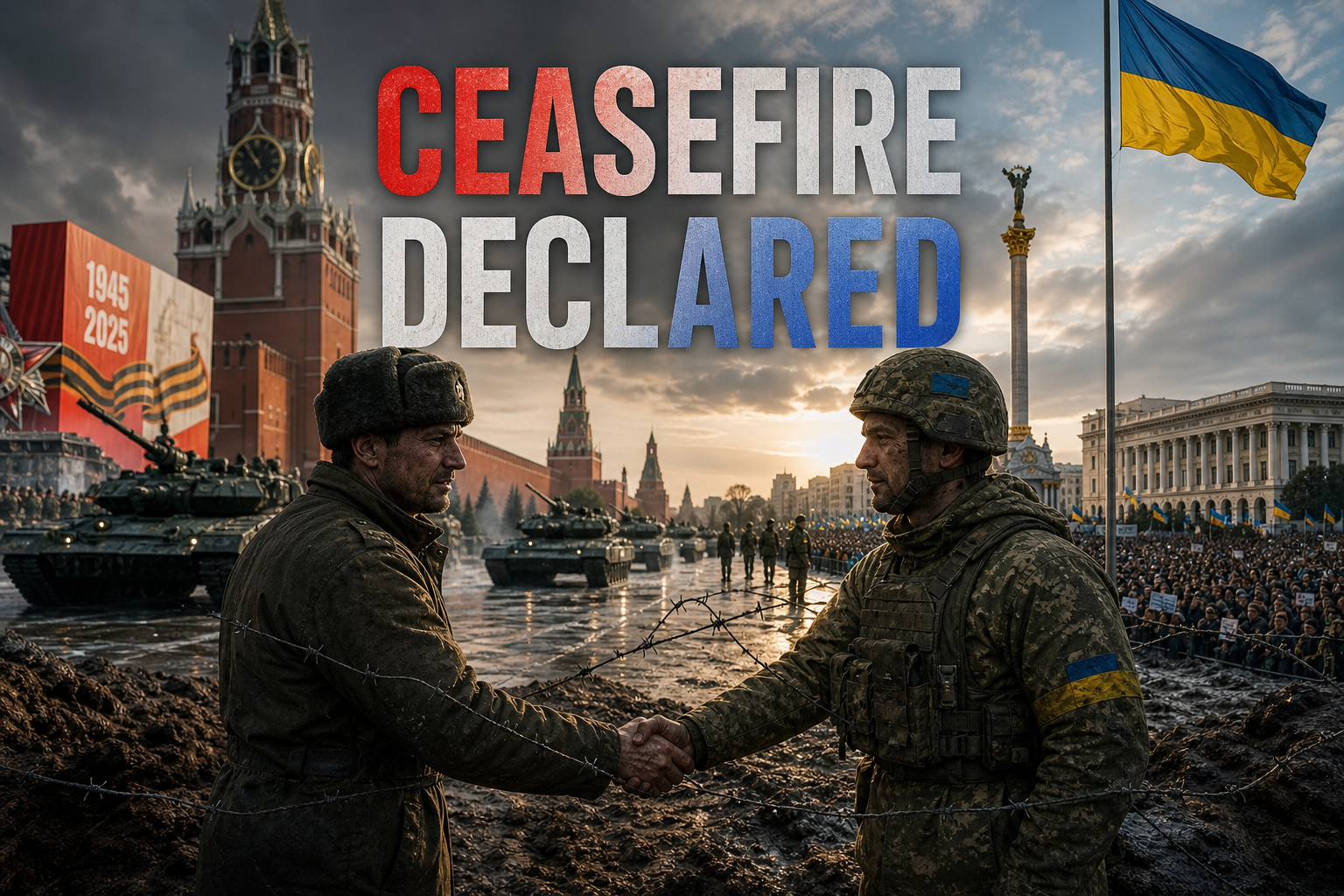
Putin’s ‘Victory Without Weapons’: Russia-Ukraine Truce Explained: In a dramatic turn on the eve of Russia’s Victory Day celebrations, both Russia and Ukraine have declared unilateral ceasefires, marking the first major halt in fighting since their full-scale invasion began in February 2022. Russian President Vladimir Putin hailed it as a “victory without major weapons,” the Kremlin’s first such claim in two decades, while Ukrainian President Volodymyr Zelenskyy framed his own truce as a “strategic reset” to regroup and negotiate from strength.
The announcements came hours before Moscow’s annual parade commemorating the Soviet victory over Nazi Germany in World War II. Putin, speaking from the Kremlin, said Russian forces would observe a 72-hour ceasefire starting at midnight, allowing “our brave soldiers to stand down while the West contemplates its failures.” He emphasised that no heavy artillery, missiles, or airstrikes would be used from the Russian side, a concession he linked to Russia’s “overwhelming territorial gains” in Donbas and southern Ukraine.
From Kyiv, Zelenskyy countered with Ukraine’s own indefinite ceasefire declaration, effective immediately in government-held areas. “This is not surrender; it’s survival and strategy,” he said in a televised address. “We pause to bury our dead, reinforce our lines, and prepare for fair talks. The occupier’s ‘victory’ is an illusion – we’ve held the line.” Ukrainian officials clarified their truce excludes active combat zones near Kharkiv and Crimea, where skirmishes continue.
A Choreographed De-escalation or Genuine Breakthrough?
Analysts see the moves as carefully timed diplomacy rather than a full peace deal. The dual ceasefires coincide with Victory Day, a symbolically potent date for Russia, and come amid mounting pressure on both sides. Russia faces economic strain from sanctions and manpower shortages, while Ukraine grapples with war fatigue, delayed Western aid, and domestic calls for negotiations.
“This is theatre with teeth,” said Dr. Elena Petrova, a fellow at the Carnegie Moscow Center. “Putin gets to parade unity at home without firing a shot, while Zelenskyy buys time for F-16 deliveries and EU membership talks. But without mediators like Turkey or China, it could unravel fast.”
Eyewitness reports from the frontlines paint a mixed picture. In Zaporizhzhia, residents described an eerie quiet after weeks of shelling, with locals emerging to clear rubble. Russian state media showed soldiers laying down arms near Mariupol, but independent verification is scarce. Ukraine reported minor violations overnight, including drone activity over Odesa.
Global Reactions: Relief, Skepticism, and Next Steps
World leaders reacted cautiously. US President Joe Biden called it a “welcome breather” but urged “verifiable de-escalation.” NATO Secretary-General Jens Stoltenberg warned allies to stay vigilant, while China’s Xi Jinping offered to host talks, positioning Beijing as a neutral broker.
The UN Security Council scheduled an emergency session for Wednesday. Aid groups like the Red Cross reported a surge in ceasefire monitoring requests, hoping for humanitarian corridors to evacuate civilians from besieged areas.
For ordinary Russians and Ukrainians, the news brought fleeting hope. “We’ve lost too much – let this be the end,” said Kyiv pensioner Olena Kovalenko. In Moscow, parade rehearsals went ahead, but with whispers of peace mingling in the crowd.
As fireworks light up Red Square tonight, the world watches: is this the dawn of talks, or just another pause in Europe’s bloodiest conflict since 1945?
Source: Kremlin.ru, TASS, Ukrinform, BBC, Reuters, Carnegie, US State Dept, NATO, UN News, ICRC (verified 5 May 2026)





Leave a Reply